
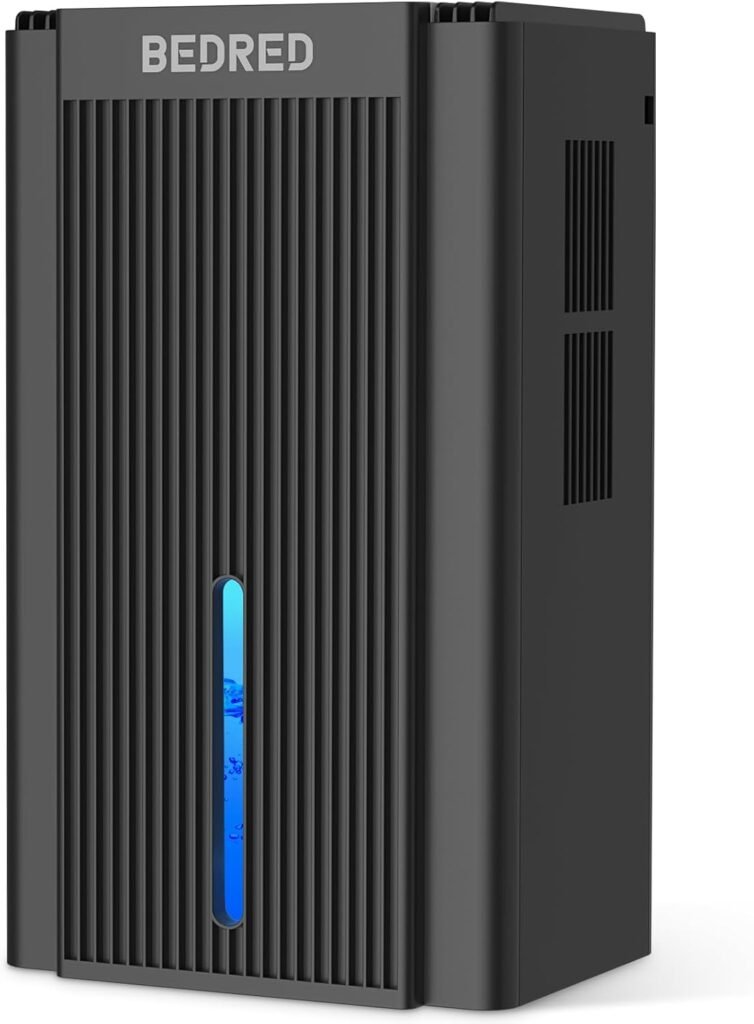
BEDRED 95Oz Dehumidifier for Home 1000 Sq.Ft
A damp room can feel uncomfortable even when the temperature itself is not especially high. Excess moisture can also show up as condensation on mirrors, damp clothing, musty odors, or moisture around walls and floors. The BEDRED 95Oz Dehumidifier is designed for residential spaces where the main goal is to reduce humidity without using the larger footprint associated with many traditional dehumidifiers.
This model uses semiconductor thermoelectric cooling to remove moisture from the air. BEDRED lists coverage of up to 1,000 square feet and combines the dehumidifying function with an automatic shutoff system, Sleep Mode, and a 7-color ambient light. Its 95-fluid-ounce water tank gives it a reasonable amount of collected-water capacity for a compact residential unit.
The important thing to understand, though, is the type of dehumidifier this is. It is an 85-watt semiconductor/thermoelectric model, rather than a large compressor-based dehumidifier. That makes its design more focused on compact residential use, quieter operation, and lower power consumption than heavy-duty moisture removal.
Quick Verdict
The BEDRED 95Oz Dehumidifier is built around a straightforward idea: provide continuous moisture removal in residential spaces while keeping the unit relatively compact and quiet.
Its strongest features are the 95-fluid-ounce tank, claimed 1,000-square-foot coverage, 28 dB quiet operation, Sleep Mode, automatic shutoff, and 7-color ambient lighting. The dual dehumidifying condenser is also a notable part of its internal design.
The main consideration is capacity versus the type of moisture problem you are dealing with. BEDRED lists a maximum moisture removal figure of 34 ounces per day under 86°F and 80% relative humidity, so buyers dealing with very heavy or persistent moisture should consider that specification carefully rather than assuming the 1,000-square-foot coverage means the unit will remove large amounts of water quickly.
For bedrooms, bathrooms, living areas, basements, and similar residential spaces where compact moisture control is the priority, the feature set is well matched to everyday use.
What’s Included
→ Tank
The tank as the included component. The 95-fluid-ounce tank is designed to collect the moisture removed during operation and can be removed for emptying.
Dual Dehumidifying Condenser for Moisture Removal
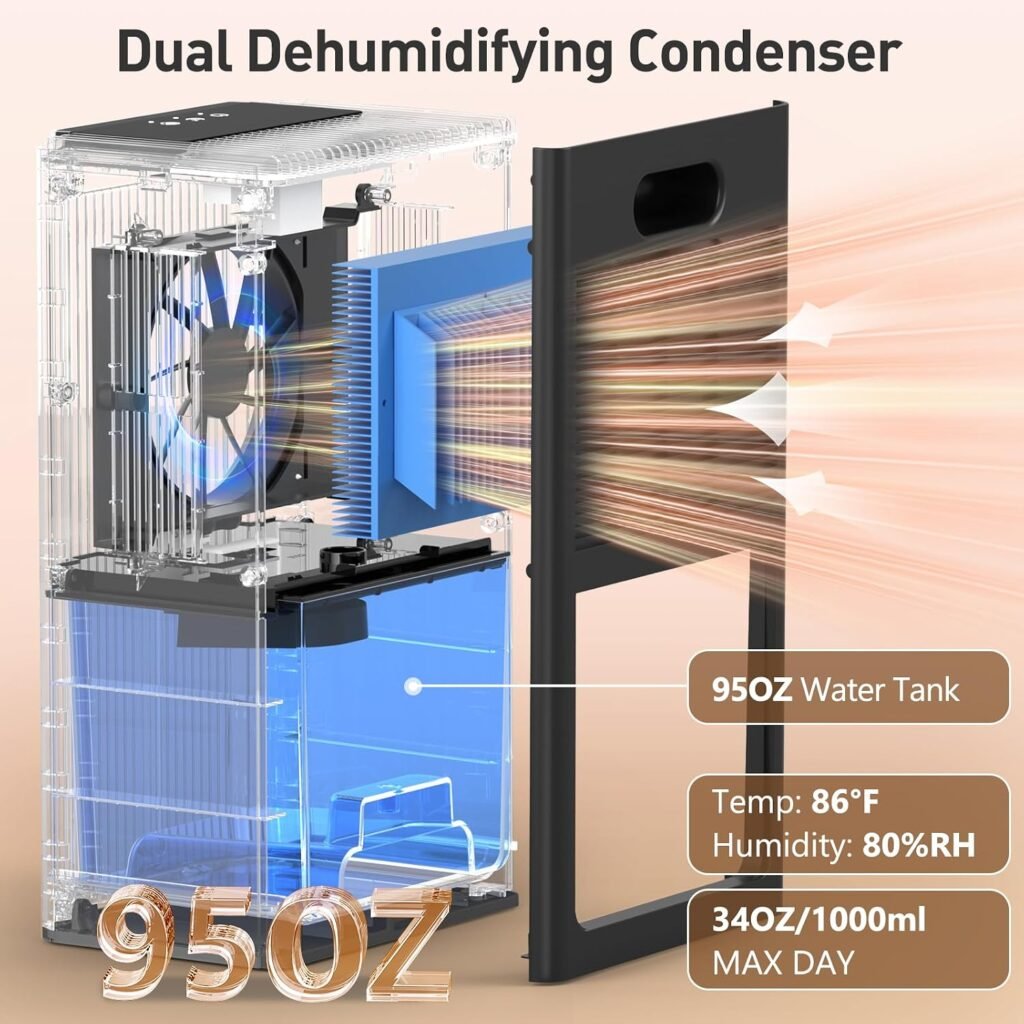
The BEDRED uses a semiconductor thermoelectric cooling system rather than a conventional compressor-based design. The product materials describe a dual dehumidifying condenser that draws moisture from the air and collects the resulting water in the internal tank.
This type of system is important because it defines how the machine is intended to be used. Instead of positioning the BEDRED as a large commercial-style moisture remover, the product is presented as a compact residential dehumidifier for bedrooms, bathrooms, basements, living spaces, and similar areas.
BEDRED lists a maximum dehumidification figure of 34 ounces per day at 86°F and 80% relative humidity. That number is useful when judging the product realistically. The advertised 1,000-square-foot coverage describes the stated area, but actual moisture removal will depend on the conditions inside the space.
For a room with moderate moisture where the goal is to keep humidity under better control, this specification gives you a clearer picture of what the unit is designed to handle.
95-Fluid-Ounce Water Tank
The unit has a 95-fluid-ounce water tank, which is one of its most important practical features. As the dehumidifier removes moisture, the water is collected inside this tank rather than requiring a separate container.
The tank can be removed when it needs to be emptied. BEDRED also provides a simple emptying process: remove the tank, take off the tank lid, pour out the collected water, close the cover, and place the tank back into the dehumidifier.
A larger tank is useful because it provides more room for collected moisture before the unit needs attention. However, how frequently you need to empty it will depend heavily on how humid the room is and how much moisture the machine is actually extracting.
The tank capacity therefore works best when considered alongside the stated 34-ounce-per-day maximum removal figure rather than as a standalone measure of performance.
Coverage Rated for Up to 1,000 Square Feet
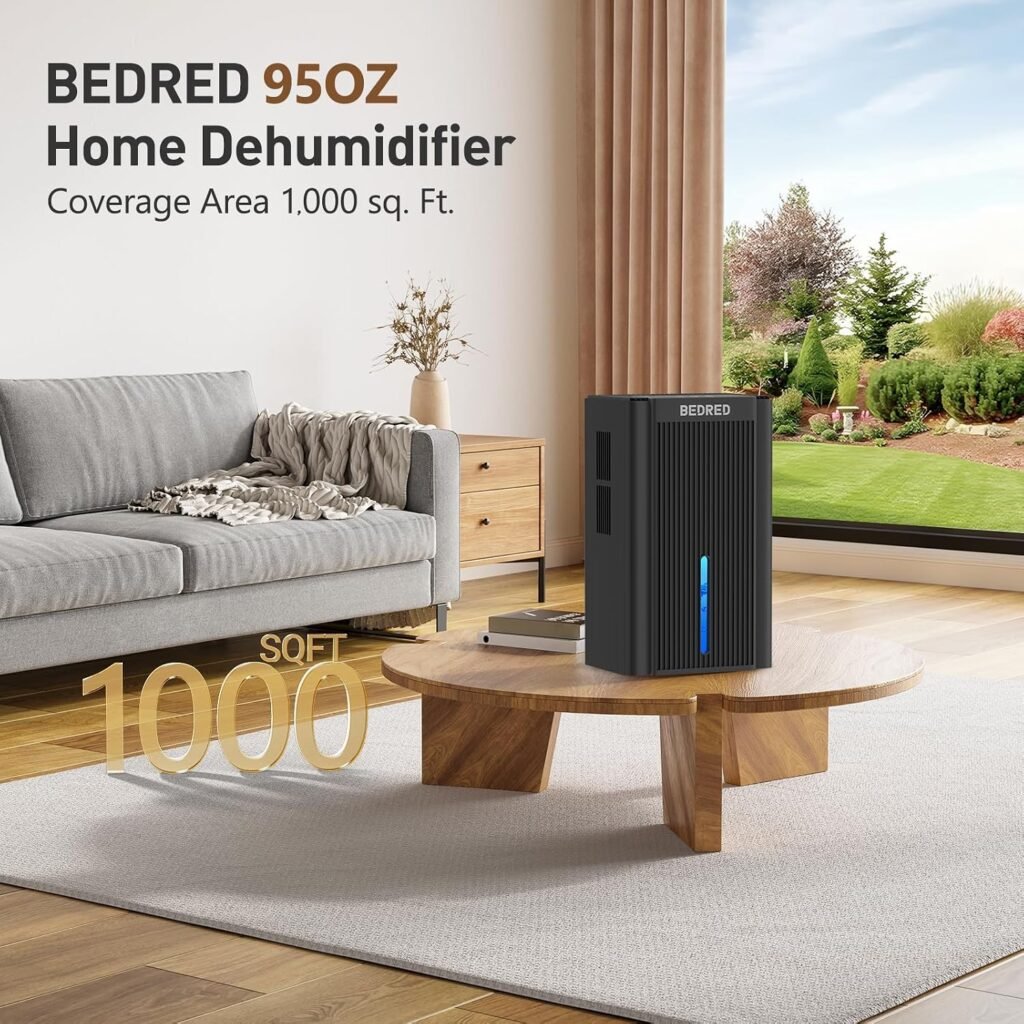
BEDRED lists this model for spaces of up to 1,000 square feet, giving it a broader stated coverage area than a basic desktop moisture absorber or very small personal dehumidifier.
That makes the specification relevant for buyers looking at residential spaces such as bedrooms, living rooms, bathrooms, basements, and other areas where moisture can become noticeable.
At the same time, square-foot coverage should not be interpreted as a guarantee that every 1,000-square-foot space will experience the same humidity reduction. Room temperature, starting humidity, airflow, insulation, moisture sources, and the layout of the space can all affect how a dehumidifier performs.
The 1,000-square-foot rating is therefore best viewed as the manufacturer’s stated coverage figure, while the 34-ounce-per-day removal specification provides additional context about the unit’s actual moisture-removal capacity.
28 dB Quiet Operation for Bedrooms
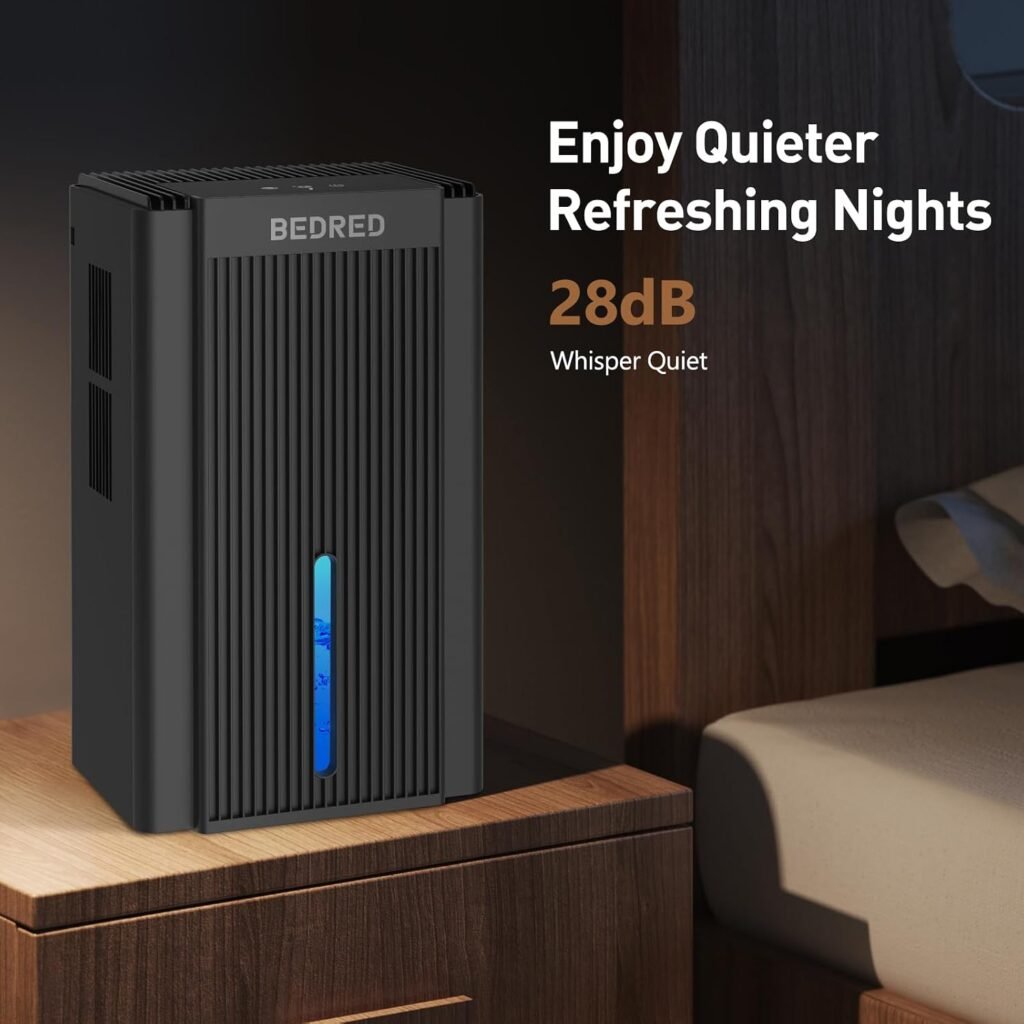
Noise matters more with a bedroom dehumidifier because the machine may need to operate for extended periods, including during the night. BEDRED lists a 28 dB noise level and specifically positions the unit as a quiet option for nighttime use.
That specification is paired with Sleep Mode, giving the BEDRED a feature set aimed at users who do not want bright lights or unnecessary operating noise interfering with their sleeping environment.
The compact form also makes it easier to position the unit in a bedroom without giving it the visual presence of a much larger floor-standing appliance.
For buyers specifically searching for a quiet dehumidifier for a bedroom, the combination of the 28 dB claim and Sleep Mode is one of the more relevant aspects of this model.
Sleep Mode Turns Off the Display and Ambient Lighting
Sleep Mode is more than simply a lower-noise setting. The product materials state that the atmosphere lights turn off and the display is turned off during Sleep Mode.
That makes the feature particularly relevant for nighttime operation. Instead of having the 7-color ambient lighting active while you sleep, the unit can operate without the decorative lighting.
The product is therefore trying to solve two different requirements at once: moisture control and a less visually distracting nighttime setup.
If you plan to place the BEDRED in a bedroom, Sleep Mode is one of the features worth paying attention to because it directly changes the way the unit behaves during nighttime use.
Automatic Shutoff When the Tank Is Full
The automatic shutoff system is an important practical safety feature. When the water tank becomes full, the dehumidifier automatically powers down rather than continuing to operate with a full collection tank.
This means you do not have to keep checking the tank every few minutes while the machine is running. Once the tank reaches its full level, the unit stops and can be emptied before operation resumes.
The feature is especially useful during longer operating periods, including overnight use. It also works naturally with the 95-fluid-ounce tank: the machine collects moisture until the tank reaches its limit and then shuts itself off.
Automatic shutoff does not remove the need to empty the tank, but it reduces the risk of the machine continuing to operate after the collection capacity has been reached.
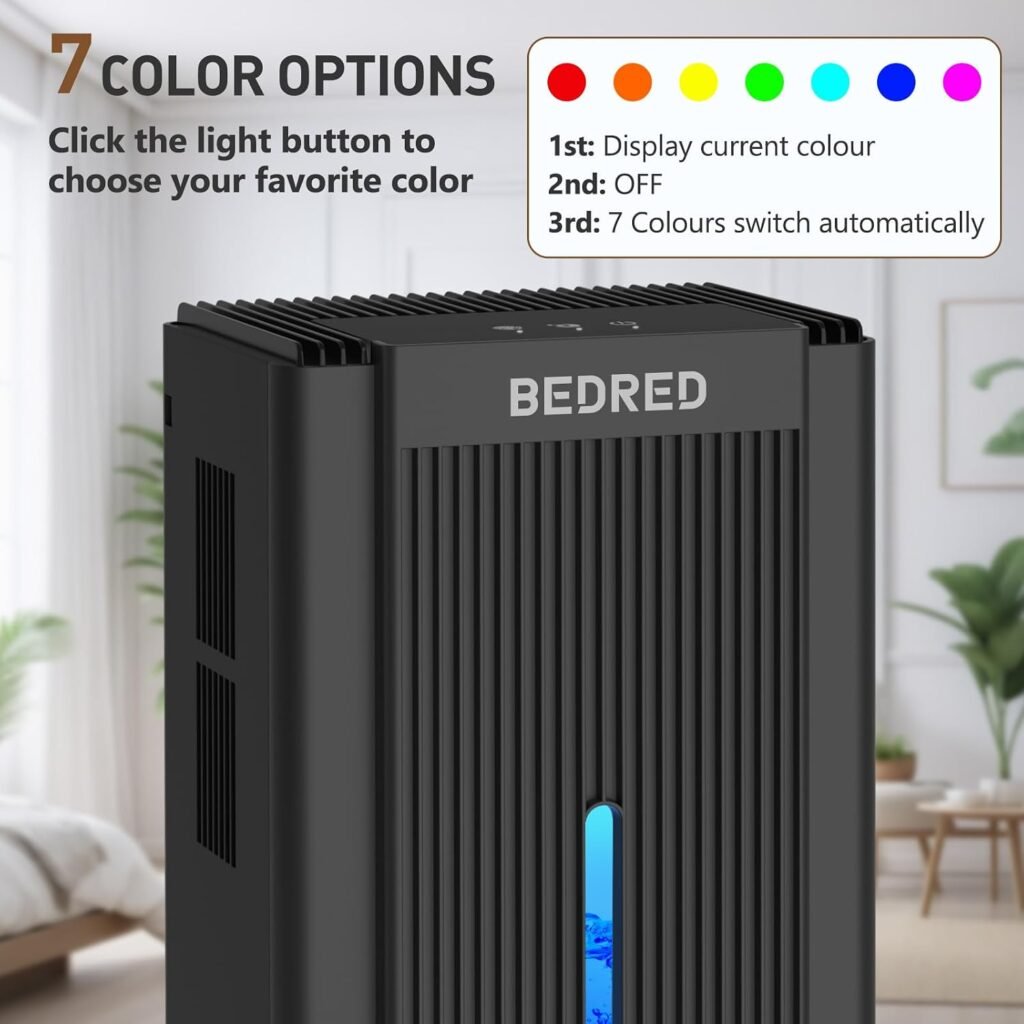
7-Color Ambient Light
The BEDRED also includes a 7-color ambient light, which gives the unit a decorative feature that is separate from its primary dehumidifying function.
The light can display different colors, and the product information states that the light button can be used to switch the lighting on or off. The listed color options include blue, green, red, and other colors, giving users several choices for the room’s atmosphere.
This feature will not improve moisture removal, so it should be viewed as an extra rather than a reason to choose the dehumidifier by itself. Its practical value depends on where you plan to place the unit.
For a bedroom or living space where the appliance remains visible, the ambient light can make the product feel more like part of the room setup rather than simply another appliance. For nighttime use, however, Sleep Mode turns the atmosphere lighting off.
Compact Residential Design
The BEDRED measures 6.7 inches deep, 8.7 inches wide, and 14.6 inches high, with a listed weight of 5.83 pounds.
Its upright rectangular design gives it a relatively narrow footprint compared with its height. The black polypropylene body also gives it a simple appliance-style appearance that can fit into bedrooms, bathrooms, living rooms, basements, and other residential spaces.
The product description specifically mentions use in a home, bedroom, bathroom, basement, living room, and even an RV. Its recommended-use classification is residential.
Because the unit is not a particularly wide appliance, placement becomes easier in spaces where floor area is limited. You still need to leave appropriate clearance around the air openings and place the unit where it can operate properly.
85-Watt Power Consumption and Energy-Saving Positioning
The BEDRED is rated at 85 watts, which is relatively modest for a household dehumidifier. The product materials also state an energy-use figure of 0.96 kWh per day.
These figures should be considered separately rather than treating the daily figure as a guaranteed result for every household. Actual electricity use can vary with operating conditions and how long the unit runs.
The semiconductor design is part of the product’s energy-saving positioning. For buyers who want a smaller dehumidifier for regular residential moisture control without moving to a much larger appliance, the 85-watt rating is an important specification to consider.
It is also worth remembering that lower power consumption and moisture-removal capacity are connected trade-offs. A compact 85-watt thermoelectric unit should not automatically be compared with a much larger compressor dehumidifier solely by room-size numbers.
Easy Tank Emptying
The tank-removal process is designed to be straightforward. The tank can be taken out of the unit, its lid removed, and the collected water poured away before the lid is replaced and the tank is returned.
This matters because tank maintenance is part of normal dehumidifier ownership. Even with automatic shutoff, the collected water still needs to be emptied before the unit can continue operating.
The 95-fluid-ounce capacity gives you a defined collection limit, while the automatic shutoff provides a clear stopping point when that limit is reached.
Real-World Performance Considerations
A dehumidifier’s advertised room coverage does not tell the whole story. The BEDRED is listed for up to 1,000 square feet, but its moisture-removal specification is 34 ounces per day under 86°F and 80% relative humidity.
That makes the operating environment important. A mildly humid bedroom is a different challenge from a basement with a continuous moisture source. In a heavily damp environment, the unit may need to operate for longer periods and the tank may fill more frequently.
The BEDRED’s thermoelectric design, 85-watt power rating, 95-fluid-ounce tank, and 34-ounce-per-day maximum removal figure should therefore be considered together.
For everyday residential humidity management, the feature combination is straightforward: run the unit, allow it to collect moisture, empty the tank when required, and rely on the automatic shutoff when the tank reaches capacity.
Design & Build Quality
The BEDRED uses a polypropylene (PP) body with a tall, rectangular shape and a black finish. The front has a vertically ribbed appearance, while the side panels include ventilation openings.
The design is functional rather than decorative, although the built-in 7-color ambient light adds a more lifestyle-oriented element. The front water-level window also gives the unit a visible indication of the collected water.
Its 5.83-pound weight makes it substantially easier to reposition than many larger household dehumidifiers. That can be useful if you want to move the unit between rooms depending on where moisture is most noticeable.
The overall design is best suited to buyers who want a dedicated residential dehumidifier that remains relatively compact while still offering a larger 95-fluid-ounce tank and a stated 1,000-square-foot coverage area.
Cleaning & Maintenance
Like any tank-based dehumidifier, the BEDRED requires regular attention to the water collection tank. The basic maintenance routine involves removing the tank, emptying the collected water, closing the tank cover, and placing it back into the unit.
The automatic shutoff helps when the tank reaches capacity, but it does not eliminate routine maintenance. The tank should be kept clean and dry between uses as appropriate for normal appliance care.
Since the supplied product information does not provide a detailed cleaning schedule or a specific cleaning solution, those details should not be assumed beyond the manufacturer’s instructions.
The most important maintenance consideration is simple: monitor the water tank, empty it when needed, and keep the collection area clean so the unit can continue to operate as intended.
Pros & Cons
Pros
→ 95-fluid-ounce water tank: The large collection tank provides substantial space for water removed from the air before it needs to be emptied.
→ Up to 1,000 sq. ft. coverage: BEDRED lists the dehumidifier for residential spaces up to 1,000 square feet.
→ Automatic shutoff: The unit automatically powers down when the water tank becomes full.
→ Sleep Mode: Sleep Mode turns off the display and atmosphere lights while reducing operating noise for nighttime use.
→ 7-color ambient lighting: The built-in lighting provides seven color options and can be switched on or off.
→ Compact design: At 6.7 × 8.7 × 14.6 inches and 5.83 pounds, the unit has a relatively compact footprint.
→ Thermoelectric operation: The semiconductor cooling system removes moisture without the compressor-based design described for larger conventional dehumidifiers.
→ 85-watt power rating: The unit is rated at 85 watts and is also listed with an energy-use figure of 0.96 kWh per day.
Cons
→ Water tank requires manual emptying: The automatic shutoff stops the unit when the tank is full, but the collected water still needs to be removed.
→ No continuous-drain feature is listed: The provided product information identifies a removable 95-ounce tank but does not list a hose-based continuous drainage system.
→ Maximum moisture-removal figure is 34 ounces per day: The product description specifies this figure under 86°F and 80% relative humidity, so actual moisture collection can differ under other conditions.
→ Residential use only: The product information lists its recommended use as residential.
→ Limited control information: The supplied specifications identify intermittent operation, Sleep Mode, automatic shutoff, and ambient lighting, but do not list advanced humidity-control settings.
Best For
→ Bedrooms: Sleep Mode turns off the display and atmosphere lighting and is designed for quieter nighttime operation.
→ Bathrooms: The compact design and stated residential use make it suitable for bathroom moisture-control applications.
→ Basements: The product is specifically presented for basement use and is rated for residential spaces up to 1,000 square feet.
→ Living rooms: BEDRED lists the unit for residential living spaces and gives it a maximum stated coverage area of 1,000 square feet.
→ RV use: The product description specifically mentions RVs among its intended locations.
→ Users who want automatic shutoff: The unit stops automatically when the 95-ounce water tank becomes full.
→ Users who prefer a compact design: Its 6.7 × 8.7 × 14.6-inch dimensions and 5.83-pound weight make the physical unit relatively compact.
→ Nighttime users: The combination of Sleep Mode, display-off operation, and the listed 28 dB noise level is suited to nighttime use.
Not For
→ Commercial applications: The product’s recommended use is listed as Residential, so it is not presented as a commercial-use dehumidifier.
→ Users who do not want to empty a water tank: The product uses a 95-fluid-ounce collection tank, and the supplied information does not list a continuous-drain option.
→ Buyers needing a higher stated moisture-removal capacity: The product information specifies a maximum removal figure of 34 ounces per day under 86°F and 80% relative humidity.
→ Users looking for advanced humidity-control specifications: The supplied product information does not list a target humidity setting or other advanced humidity-control function.
FAQs
How much water does the BEDRED dehumidifier collect?
The water tank has a capacity of 95 fluid ounces.
Does the BEDRED dehumidifier shut off when the tank is full?
Yes. The automatic shutoff feature powers the unit down when the water tank becomes full.
What size room can the BEDRED dehumidifier cover?
The product is listed for spaces of up to 1,000 square feet.
What type of dehumidifier is the BEDRED CT11?
It uses semiconductor thermoelectric cooling to remove moisture from the air.
How much moisture can it remove per day?
The product description specifies 34 ounces per day under conditions of 86°F and 80% relative humidity.
Is the BEDRED dehumidifier suitable for a bedroom?
Yes. The product description specifically lists bedrooms as a suitable location and includes Sleep Mode for nighttime operation.
Does it have Sleep Mode?
Yes. Sleep Mode turns off the display and atmosphere lights and is designed to reduce noise during nighttime operation.
Does the BEDRED have colored lights?
Yes. It has 7-color ambient lighting, and the product information states that the light can be switched on or off.
Can the ambient light be turned off?
Yes. The product instructions state that the light button can be used to switch the ambient light on or off. Sleep Mode also turns the atmosphere lights off.
What is the noise level?
The product information lists a 28 dB noise level.
How much power does it use?
The listed wattage is 85 watts. The product materials also state an energy-use figure of 0.96 kWh/day.
What happens when the water tank is full?
The automatic shutoff activates and powers the dehumidifier down. The tank can then be removed, emptied, closed, and placed back into the unit.
Does it have a continuous drainage option?
The supplied product information does not list a continuous-drain or hose connection feature. It describes a removable 95-fluid-ounce tank.
Where can the BEDRED dehumidifier be used?
The product description mentions the living room, bedroom, bathroom, basement, and RV. Its recommended use is residential.
Final Verdict
The BEDRED 95Oz Dehumidifier is a compact residential moisture-control unit built around semiconductor thermoelectric cooling. Its main features include a 95-fluid-ounce water tank, up to 1,000-square-foot stated coverage, automatic shutoff, Sleep Mode, 7-color ambient lighting, and an 85-watt power rating.
The 95-ounce tank and automatic shutoff make the water-collection process straightforward: the unit collects moisture until the tank is full, then stops automatically. The tank can be removed and emptied before the dehumidifier is returned to operation.
Its Sleep Mode is particularly relevant for bedroom use because it turns off the display and atmosphere lighting while providing quieter operation. The 7-color lighting is an additional feature that can be switched on or off depending on how you want the unit to operate.
The most important specification to consider is the 34-ounce-per-day moisture-removal figure, which is stated under 86°F and 80% relative humidity. The 1,000-square-foot figure describes the listed coverage area, while actual moisture collection depends on the operating conditions.
For residential buyers looking for a compact dehumidifier with a large 95-ounce tank, automatic shutoff, Sleep Mode, and optional ambient lighting, the BEDRED CT11 provides a focused set of features for bedrooms, bathrooms, basements, living spaces, and RV use.